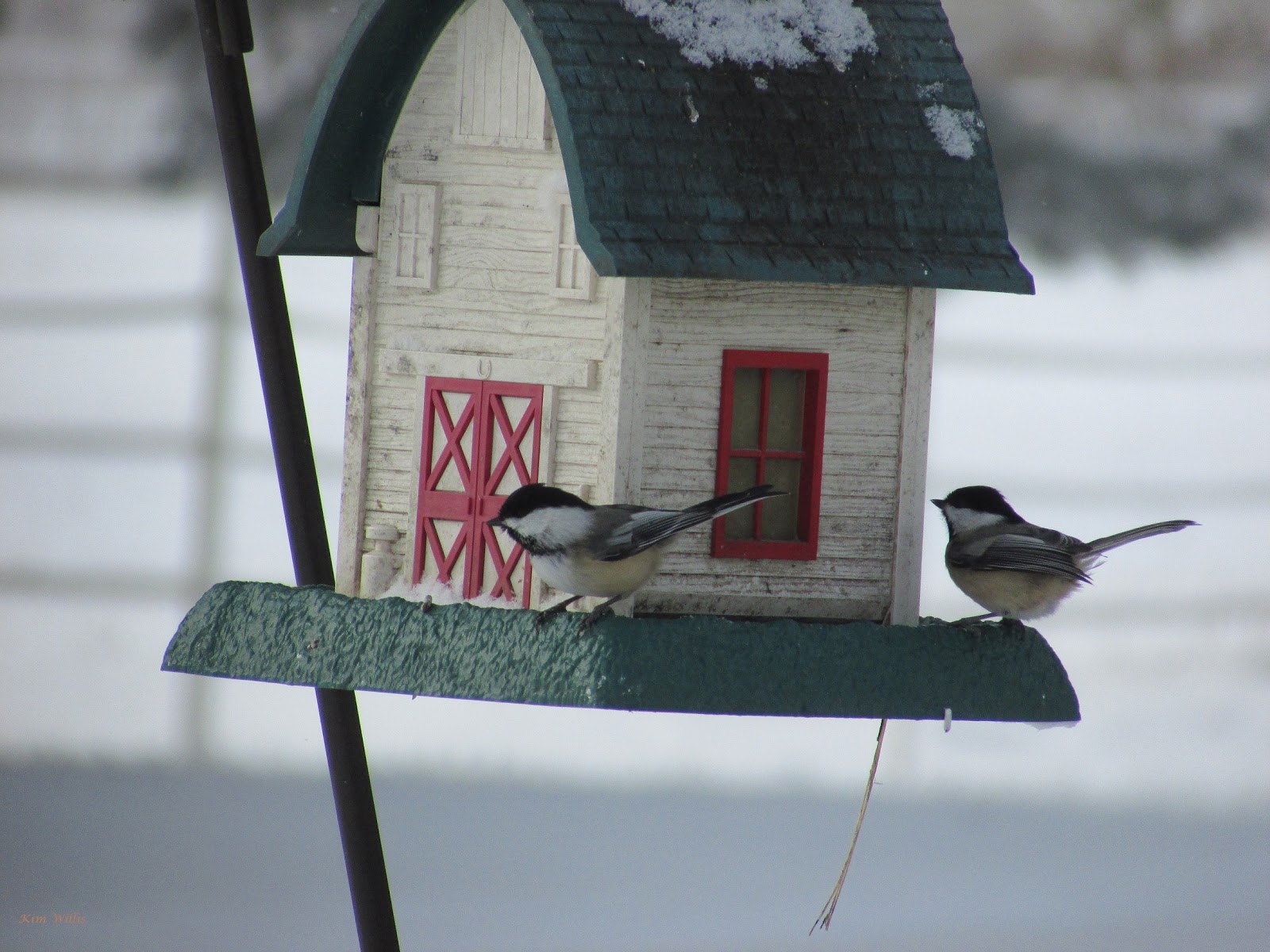
Well the sun is shining but with about 7 inches of
snow, 21 degrees and a brisk breeze it’s not a nice day. Lake effect snow yesterday left us with a deep
dose of unwanted winter. The birds are piling on the feeders this morning. Needless
to say, nothing is blooming in the garden today, but some trees and shrubs
still have their leaves.
Well the sun is shining but with about 7 inches of
snow, 21 degrees and a brisk breeze it’s not a nice day. Lake effect snow yesterday left us with a deep
dose of unwanted winter. The birds are piling on the feeders this morning. Needless
to say, nothing is blooming in the garden today, but some trees and shrubs
still have their leaves.
There are good things that snow does. With bitter
cold setting in for a few days the blanket of snow may protect things that haven’t
fully hardened off for winter. And the
snow reflects lots of light back into my windows for the plants inside. Inside things are blooming away, hibiscus, pomegranate,
Thanksgiving cactus, streptocarpus, begonias, geraniums, gerbera daisy, diplodenia,
penta and peace lily. There’s even a
bloom on my big lemon tree.
I haven’t heard snowmobiles yet, no one had theirs
ready to go yet I guess. That’s a good
thing. Many of the farm fields haven’t been harvested, and snowmobilers are
notorious for trespassing across the fields. If the snow melts in a week or so
maybe the poor farmers will get the fields harvested. But I am thinking that
some of those fields won’t be worth harvesting.
It’s been a terrible year for farmers. Between the
trade wars and the weather, they have been hit hard. Small farmers have been
told by Perdue, the current Secretary of Agriculture, that they need to go big
or get out. Suicides of farmers and calls to suicide
prevention lines for farm families are up. If you know a farmer tell him or her
you appreciate them and to hang in there.
This week’s blog is all about the contributions to
agriculture, gardening and culture that the peoples native to the Americas gave
us, since it’s Native American Month. We
should all reflect on the contributions to our culture that the First People on
this continent gave us. History is finally being corrected to provide a more
balanced and honest assessment of what was achieved before the arrival of
Europeans and what was lost by the invasion of a non-native “species”.
Reflecting on Native American contributions
to our food and culture
It’s Native American month and time for gardeners to
remember some of the things the First People of the country gave us- besides
this land. The common perception many Americans have is that when Europeans first
came to this country it was just vast wilderness with a few tribes of Native
Americans living in tepees and bark homes, hunting and fishing to
survive. Archaeologists tell us that just
wasn’t true.
Across the Americas, before Europeans arrived, there
were millions of people in thousands of communities and cultures. Some cultures
were as advanced as those in Europe and Asia at similar times. These
different groups/ tribes knew of each other and trade between cultures was
frequent. Some cultures were nomadic, following game and moving with the
season, others were agricultural and settled permanently. They wove and made
pottery, mined metals and made intricate jewelry, domesticated plants and farmed
enough food to feed large populations.
Cabeza
de Vaca, an explorer from Spain in 1527 described a city in what is now
Arizona, of Pueblo people, who he said, had cotton blankets finer than those at
home, large,permanent homes and great stocks of grain. French explorers in the
north described large settlements of native people farming land and managing
fruit and nut orchards along the St. Lawrence river and down along the
Mississippi river. They described large, well-tended farm fields covering many
acres. (The French settlement of Quebec and its fort were built in 1608, well
before the Plymouth Rock colony struggled to take hold.)
But by
the time the Europeans became successfully established and moved further inland
the First People’s populations had been drastically reduced. Diseases brought in by those early explorers,
measles, influenza, cholera, and others had swept through the populations, who
had no immunity to them, killing millions. Fields were abandoned, homes
crumbled into dust.
When
200 years or so later early European pioneers began migrating from those
initial coastal colonies into what they thought was unclaimed and untouched
wilderness, they were merely seeing what nature does to heal itself when humans
leave. The Native people before them had introduced new species, changed the
soil and topography and managed wildlife.
But now those efforts went unseen.
The
first true slaves in the nation held by Europeans were Native Americans. (To be
fair Native Americans also kept slaves). Diaries of Spanish explorers describe
the cruelty that was meted out to the people enslaved by the first invaders. They
used them as guides, pack animals and to mine for precious metals. They took
what they wanted from Native people, food and homes, and their contact began
the series of disease epidemics that would wipe out indigenous populations from
South America to North America.
Later
the English would use Native American slaves as farm labor. Their experience
with crops that would grow in this country was helpful. But the Native
Americans did not make “good” slaves.
They knew the country and escaped into it easily. They were also
susceptible to dying from diseases their captors gave them. Europeans then
turned to importing black slaves.
So,
as it can be said of black slaves, Native American slaves helped get this
country established. Between helping the first Europeans survive, helping
European countries fight their wars on American soil and slave labor, Native
Americans had a great part in establishing the countries that now exist on this
continent.
Native American food contributions
Native
Americans (from South and North America) introduced Europeans to many new
foods, corn, several types of beans, tomatoes, peppers, potatoes, sweet
potatoes, peanuts, pecans, cashews, black walnuts, agave, Jerusalem artichoke, quinoa,
amaranth, arrowroot, sunflower, wild rice, pineapple, pumpkin/squash, cocoa
bean (chocolate), vanilla, cranberries, blueberries, cassava, papaya, avocado,
turkey, bison, salmon and muscovy duck to name a few. About 60% of the typical
western diet today consists of foods that originated in the Americas.
Corn
A note
about the word “corn”. Corn is an English word for grain of all sorts. In
Europe corn could be oats, barley, wheat or other grain. When Europeans were
given “maize” by Native people they applied the word corn to it also. In this
article corn is Zea mays or in common language maize.
Corn is
probably the most important contribution to food/agriculture that Native
Americans gave the world. Corn was first developed by people in Central America
starting about 7000 years ago. It was developed by selective breeding from a
plant called teosinte. Hundreds of varieties were in existence by the time
Europeans arrived and corn was being grown as far North as what is now Canada. Even
people who were nomadic hunter cultures often traded for the corn and used it as
a basic food.
Corn is
still immensely important to North American agriculture and is now grown around
the world. There are still hundreds of
varieties and hundreds of uses for corn. Corn is used as food for people, food
for animals, ethanol, drinking alcohol, oil, cornstarch and as a sweetener,
corn syrup.
While
early Native American corn did come in yellow and white varieties, many
varieties had beautifully colored kernels of red, pink, blue, black and green
or mixed colors. Different colors often denoted different uses for the kernels,
such as making flour, making hominy, or popping. There were varieties for different climates
and soil conditions. The idea of growing a crop variety best suited to an area
was understood by early Native American farmers.

Corn
was planted separated by color and the use for which it was being grown. Even the early indigenous farmers knew corn
had to be separated if they wanted the kernels to be a specific type. There was
corn for flour, corn for making hominy, corn for parching, corn for popping,
and so on. Beans, squash or sunflowers were often used to separate corn fields.
Native
Americans were the inventors of hominy. To make hominy corn is dried, then the
dried corn is soaked in a lye solution (lye is made from wood ashes) then
washed several times and dried again. Why go through all of this? Because humans cannot absorb niacin from corn
unless it is treated like this, and a diet based largely on corn would lead to
a niacin deficiency, (pellagra). Of course, indigenous people did not know it
was a lack of niacin that caused sickness, but they had realized that corn
treated like this kept the sickness away.
Hominy
also stores better, the kernels do not germinate if they get moist, and the
kernel hull is softened and easy to remove.
Hominy was often ground into flour as well as untreated corn. That flour
was used in “breads” and in soups and stews.
 |
| Doll made from corn husks |
Popcorn
is also a Native American “invention”.
Archeologists have found evidence of popped corn dating to around 3600
BC. Popcorn was probably the first type
of corn domesticated into a pure variety. That was in South and central America
but by the time Europeans began settling on the continent popcorn was known and
grown through most of North America too. That first harvest dinner celebrated
by the pilgrims had popcorn brought by Native Americans.
Popcorn
was eaten and was also used for ceremonies and decoration by indigenous people.
Several varieties of popcorn were grown by various cultures. Native Americans popped corn in clay pots, on
cobs held by sticks over fire and by throwing kernels into a fire. A game was made of catching the popped
kernels that flew out of the fire. Early
settlers used popcorn as a breakfast food, with milk and sugar, and this
probably inspired the breakfast cereals we now enjoy.
Beans
There
were beans and peas in Europe and Asia before the New World was discovered, but
many of the most common beans we eat today come from the American species Phaseolus
vulgaris. This includes Navy Bean, Red Kidney, Pinto, Great
Northern, Marrow, and Yellow Eye. It also includes all beans called snap or “green”
beans, where the pods are consumed.
Where
corn was grown indigenous peoples almost always grew beans. These two foods compliment each other, the
beans adding protein and other nutrients corn lacks in sufficient quantity and
together form a more nutritious diet. Beans are also easy to dry and store or
transport.
All the
native beans were vining types. If corn
was not used to support the vines brush or poles were sometimes used or the
vines simply sprawled on the ground. Like corn, indigenous species of beans
came in a wide variety of seed colors and patterns. Some of these beans are so
beautiful they were used in decorative ornaments. Different cultures had unique bean varieties they
preferred to grow.
Succotash
is a combination of beans, corn and often peppers. It is a very nutritiously
balanced food, containing all essential amino acids. This is a food indigenous people
introduced Europeans to that would help save their lives.
Squash
and pumpkins – and gourds
Despite
the story of Cinderella, which seems ancient and linked to the old world, pumpkins
and squash are American in origin. Four species,
C. maxima which includes most winter squash and some large pumpkins,
C. pepo which includes the small pie pumpkins, acorn squash,
vegetable spaghetti, zucchini, and other summer squash, C. moschata which includes
butternut squash and a few others and C. mixta which includes the
cushaw varieties are the American squash species.
Like
beans and corn there were hundreds of varieties of squash. Often squash was
grown at the edges of corn fields or between rows, but some fields were planted
with only squash. And squash was part of the 3 sister’s method of growing I’ll
discuss later. Some of the harder
shelled winter squash types were stored whole for winter, but most squash was
cut into circles or strips and dried for storage. Squash was often used in
soups.
The seeds
of squash were also important as food.
They were roasted, dried and stored and were part of many indigenous dishes. They were used as “travel” foods and snacks.
Gourds,
which are related to squash, have a very long association with humanity and
their origins are a bit murky. While gourds were present in the Americas long
before European contact, they probably didn’t originate here. Science now believes the bottle type gourds
originated in Africa. The genus Lagenaria has six species which comprise
most of the “hollow”, hard shelled gourds.
I
mention gourds here because all cultures around the world have a record of
gourd use very early in their civilizations.
Gourds probably came with the first migration of people from Africa and
went wherever people went from that point on. They are found in Peruvian
archaeological sites dating from 13,000 to 11,000 BC. Before European contact
gourds were being used by every Native American culture from south to north.
What
makes gourds so special? They hold things. Before we had clay pots and woven
baskets, we had gourds. They can carry water, seeds, fat, medicine, you name
it. They were made into musical
instruments, such as rattles, flutes and stringed instruments. They were
ornaments, gourds were carved and painted, and eating and cooking utensils,
sometimes even cradles. Gourds were an essential part of every human
civilization. Sometimes they were collected from the wild, but often they were purposefully
grown.
 |
| Gourd serving dish and utensils Wikimedia commons |
One of
the interesting things noted in the accounts of early European explorers of North
America was that some native cultures used gourd birdhouses to attract Purple
Martins and other birds around their villages in the hopes they would control
mosquitoes. They are still used as bird houses today.
Like
beans, corn, squash and other crops there were hundreds of varieties of gourds
in America. Some were huge, some small,
some colorful, many unique to a group of people over generations of time.
Years ago,
I was fortunate to be given some seeds descended from seeds found in an ancient
southwest Native American archeological site. Someone was able to germinate
some of the seeds and grow out some gourds from them and they distributed the
seeds from those gourds to a number of Master Gardeners. (These seeds were at
first called squash seeds.)
Peanuts
Did you
think peanuts came from Africa with black slaves? Well they may have but that’s not the whole
story. Peanuts are native to South America. In Peru thousands of years ago
peanuts were being turned into peanut butter, roasted in the shell, fried,
boiled, and made into flour. Peanuts roasted in the shell were eaten at ceremonies
and games just as they are today.
Since
we know peanuts had found their way into Mexico from Peru by the time Europeans
arrived, Natives in southwest North America may also have peanuts. But it was
the Portuguese who brought them from Brazil to Africa in the 1500’s.
Africans
quickly found many uses for the peanut and they grew well there. Peanuts were introduced back into
southeastern North America by African slaves. They once again became an
important crop in the Americas. And roasted peanuts are still eaten at games
and ceremonies.
The
maple sugar controversy
There
is some controversy as to whether Native Americans actually converted maple sap
to sugar before European contact. (Maples
grow in Europe and other places but there is no history of making syrup and
sugar from it there.) At the present
time it is believed that Native Americans in the Northeast before European
contact did collect maple sap and boil it into syrup using primitive vessels.
But it is now believed that they could not have processed the sap into sugar
until they had iron kettles. Experiments
have found sap can be reduced to syrup in clay and wood vessels, but most
experiments found sugar impossible to make in such vessels.
 |
| An example of Native American technique for maple syrup Wikimedia common |
There
are many legends and words associated with “maple syrup” in various Eastern
tribe’s languages that linguists say pre-date colonial history and support this
idea. Also, early French explorers wrote
of the Natives drinking a sweet liquid in the spring made from trees.
By the
1600’s, when natives were getting trade goods like iron kettles from Europeans,
they learned to further boil down syrup into sugar. The sugar stores and
transports well and it is at this point in time when maple sugar became a trade
item, and more of a spring industry, for Native Americans. It was traded to Europeans, who had cravings
for cane sugar, and to other tribes outside the sugaring country.
In
either case, it was Native Americans who developed the process of making maple
syrup and sugar, before and after technology from Europeans. So, it is fair to
say that Native Americans gave us those foods.
Sunflowers
Sunflowers
are native to the Americas. Not only
were there dozens of varieties of corn, beans and squash, sunflowers were also
selectively bred into distinct varieties. The sunflower was probably the
closest thing to an ornamental that early Native Americans grew but it was also
a source of food.
Sunflowers
were being grown as a crop as early as 3000 BC., probably in Central
America. It is thought that they were
domesticated before corn. The First People developed the plant by selective
breeding to have one large head and a lot of seeds. They produced tall sturdy
stalks. They also cultivated plants with different colored ray flowers and
seeds, and some of these varieties were probably also grown for their beauty.
The use and growing of sunflowers spread north and west until most First People
in North America that farmed were also growing the crop.

Sunflowers
were used for food, for dye, for oil, and they also had some medicinal uses.
The oil was used on the skin and hair and a purple dye made from sunflowers was
used to color textiles and paint the body.
As is typical of indigenous crops no part of the sunflower was wasted.
The stalks were used as building material and fodder for animals.
Other
garden plants
There
are wild species of the genus Vaccinium ( blueberry) in Northern
Europe and Asia that were used as food in some places. In Europe these were
called bilberries. But the cultivated blueberry is developed from North America
species. Huckleberries and cranberries are also native to the Americas.
The
three sisters garden misconception
Many
people think that most Native Americans farmers/gardeners grew corn, beans and
squash/pumpkins together in what white people have termed the “3 sisters
garden”. In this method a mound is made,
and the seeds of the three planted together. It is said that the corn provides
support for the beans and the squash shades the ground to conserve moisture. Sunflowers are sometimes substituted for
corn.
It is
probably true that some indigenous cultures grew crops in this way. But each culture grew crops in a different
way. Many cultures separated each crop
because they believed it was easier to care for and harvest crops grown
separately. Often squash/pumpkins were grown on the edges of fields. And sunflowers sometimes surrounded fields of
other crops.
Many
cultures used mounds to plant in, whether in three sister’s style or in long
rows. Raised beds were a useful concept then as they are now. The loose soil is deeper in mounds and
scraping soil into mounds with primitive tools was easier than digging it.
Mounds also make it easy to determine what is a row and what is a planted area.
Other early
gardening and farming techniques
Some southwestern
indigenous cultures in dry areas used irrigation canals to water crops. Some
cultures fertilized plots with animal manure. Many cultures fenced plots with
sticks and brush, and it was common to post guards around crops as they neared
harvest, both to deter animals and humans. In the Midwest platforms were built
at the edges of corn fields and young girls manned them 24 hours a day to
protect the crop. (Young men often hung
around these platforms, offering even more protection, at least for the crop.)
The
scapula (shoulder blade) of a large animal was often used as a shovel or
hoe. Some cultures carved wooden garden
tools. Women had planting sticks,
sometimes elaborately decorated. There
were woven bags and baskets to carry seeds and harvested crops. Clay pots with seals were used to preserve
seed for planting. Usually pits were dug to store dried corn and beans, often
lined with grass mats.
In
wooded lands Native Americans practiced a type of slash and burn agriculture. In
the first year, saplings were cut down and large trees girdled. In the second
year the sapling piles were burnt, dead trees removed and then crops were
planted. After the crop was planted a
new area was prepared by cutting saplings and girdling trees to expand the
growing area.
 |
| Wikimedia commons |
While
most Native Americans did not believe in the concept of “owning” land, some
cultures did believe in the concept of a gardener having control over their own
plot. It was usually women who grew food, although men helped clear land and
harvest. A woman staked out her plot in
various ways, with the older, higher “ranking” women having the best and
largest locations. A family or extended
family worked as much ground as they could.
And other people in the community respected the boundaries of that
family.
Harvests
were sometimes done by the community, with people moving from one plot to the
next, in a community effort. Men and
older people who didn’t participate in other parts of the growing often helped
in the vital harvest tasks. This is a practice many agricultural communities
around the world follow. Agriculture
does lead to more cooperation among people of a community.
When the
harvest came some of it almost always went to communal stores, but the rest was
stored by the family growing it. When a family had a crop failure or when
people could not grow their own food, it was generally shared or given from
communal stores.
In some
cultures, agriculture was more communal, with most women working in one large
plot. Men were more involved, and the harvest considered to be for the whole
community. This may have been the case in arid regions where ditch type
irrigation practices require lots of labor.
After a
few years old fields became less productive and were abandoned. If new land suitable for growing wasn’t
available, the community might move.
However agricultural societies were more likely to remain in the area
for decades and build more substantial homes.
If you
would like to know more about Native American gardening and farming you can
read the account of an elderly Native American recorded in 1918 by researcher
Gilbert L. Wilson. The book is called Buffalo Bird Woman’s Garden. This 70+ year old woman describes
gardening techniques and crops of the Hidatsa tribe, in the area of North
Dakota. It’s an interesting story and
easy to read. Amazon carries it. I wrote a review of it which you can read on
this page
Other Native
American contributions
The use
of cotton to make fiber and cloth originated in at least two areas of the world
from different species of the plant. At
around the same time use of cotton began in Pakistan and Asia, people in Peru
and Mexico were also using cotton of a different species. Cotton from the Americas was found to be
superior when the species were eventually compared, and today most commercial
cotton grown is derived from the American species Gossypium hirsutum. Gossypium
barbadense (Pima cotton) is another important species of cotton
that originated in the Americas.
We
developed several medicines from native remedies. Native Americans had a deep
reverence and respect for medicinal herbs and a lot of knowledge about them.
Medicine men, as Europeans called them, not only used “spiritual” remedies but
were very experienced in herbal medicines. Herbs known for healing properties
were traded to areas outside of where they grew naturally. Unfortunately, they
had no cures for the diseases Europeans brought with them.
Native
Americans also gave us tobacco and coca (cocaine), maybe a payback? Jerky
making and freeze drying are food preservation techniques from the
Americas. Syringes, toboggans and
snowshoes are pre-European Native American inventions.
How
Native Americans gave you the Land Grant college/Extension system
Native
Americans also gave us something, although not willingly, that many gardeners
have utilized, the land grant college system and its Extension services, which
exist in almost every county in the US.
Many of you have had soil tested, plant or insect specimens examined,
had advice given to you about growing crops or ornamentals or have taken a
Master Gardener course or other outreach courses through Extension. Native
Americans gave up their lands so you could have these services, although they
were often forced off the land or tricked off it and did not voluntarily surrender
it.
Congress
passed the Morrill Act in 1862. This act
gave each state land to start a state college. Colleges could build on the land
or sell it to build elsewhere in the state. They had to give back to the state
certain services like low cost college tuition for residents, and outreach to
the communities to share research findings about agricultural practices and
other science-based knowledge. These land grant colleges now provide a host of
programs and services to residents of the states they are in. Some of the most well-known services are the
Extension service and the 4-H programs.
So,
where did Congress get this land they so magnificently gave to the states? By this time in history large tracts of
vacant land existed mostly in places west of the Mississippi, unless you
counted land in Indian reservations, which it seems, didn’t count as occupied. So,
Congress gave away treaty lands.
For
example, Michigan State University was one of the first land grant colleges.
Congress gave it land ceded in the 1819 Treaty of Saginaw to the Three Fires
Confederacy of Ojibwe, Odawa, and Potawatomi peoples near the Red River in
Michigan. Native people were still living on the land when the college held its
first classes. This is an example of what happened across the US, lands known
as reservations or held by treaty were just simply given away to be used or
sold by state colleges.
In
states in the northeast where there wasn’t enough land not owned by white
settlers, the land grant was fulfilled by giving those states land in the west,
often reservation land. The land could be sold to provide funds to build a
college in the eastern state. The fact that this land was often part of reservations
ceded in treaties to Native Americans concerned few people, other than Native
Americans, who by now, had pretty much lost any ability to fight back.
In
recent years Michigan State and a few other land grant colleges have
acknowledged the sacrifices and indignities Native Americans suffered when
Michigan State University was built. You
can read a statement drafted in November 2018 called the land acknowledgement statement
here;
In the statement MSU pledges to “affirm Indigenous sovereignty and
hold Michigan State University accountable to the needs of American Indian and Indigenous
peoples.” Let’s hope we keep those promises better than
our ancestors kept their promises to indigenous people.
Three sister’s soup
In keeping with this week’s theme, I am going to post
a Native American recipe that’s been modernized a bit. It’s a good meal for a cold wintry day.
Ingredients
3 tablespoons butter
4 cups chicken or vegetable stock
1 cup onion, diced
1 clove garlic, minced.
4 cups chicken or vegetable stock
1 cup onion, diced
1 clove garlic, minced.
1 cup yellow corn kernels, canned or frozen
1 cup white beans, cooked
1 teaspoon curry powder
½ teaspoon salt- or to taste
¼ teaspoon ground coriander
1⁄8 teaspoon crushed red pepper
1 teaspoon curry powder
½ teaspoon salt- or to taste
¼ teaspoon ground coriander
1⁄8 teaspoon crushed red pepper
2 cups of cooked and pureed pumpkin or butternut or
acorn squash. Do not use pumpkin pie
filling.
Directions
Melt the butter in a large pot and sauté the onion
and garlic until soft.
Add the spices, beans, corn and stock.
Bring the pot to a boil then reduce to simmer and
simmer 20 minutes, stirring occasionally.
Add the pumpkin or squash, stir well. Simmer 5 minutes. Makes roughly 4 servings.
Serve with your favorite cornbread.
“The soldiers did go away and their towns
were torn down; and in the Moon of Falling Leaves (November), they made a
treaty with Red Cloud that said our country would be ours as long as grass
should grow and water flow.”
-Black Elk-
Kim Willis
All parts of this blog are copyrighted and may not be used without
permission.
And So On….
Find Michigan garden events/classes
here:
(This
is the Lapeer County Gardeners facebook page)
Newsletter/blog information
If you have a comment or opinion you’d like to share, send it to
me or you can comment directly on the blog. Please state that you want to have
the item published in my weekly blog if you email me. You must give your full
name and what you say must be polite and not attack any individual. I am very
open to ideas and opinions that don’t match mine, but I do reserve the right to
publish what I want. Contact me at KimWillis151@gmail.com